
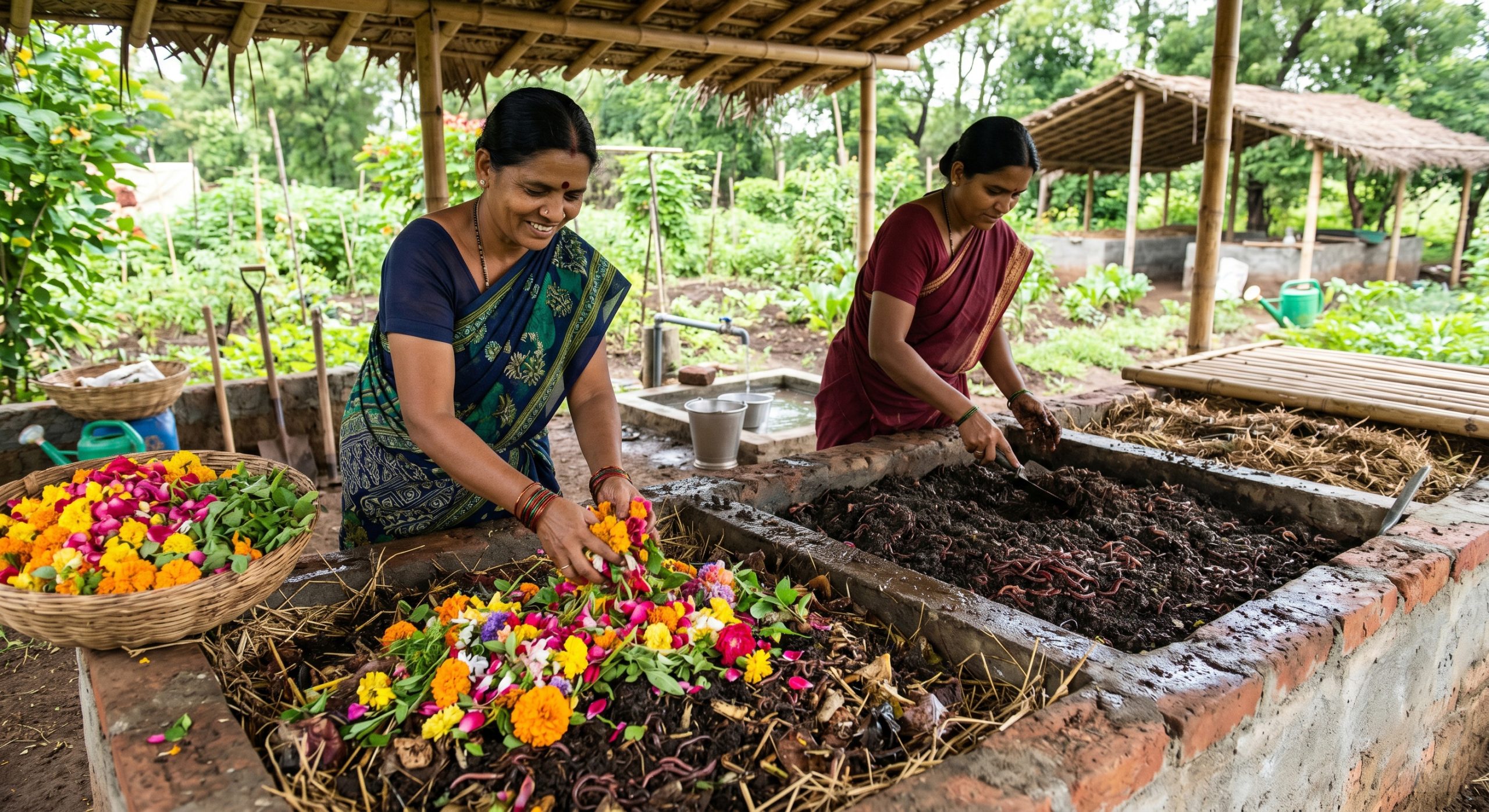
From Sacred Offerings to Black Gold: The Women Transforming India’s Temple Waste
In India, the transition from “devotion” to “disposal” has long been a source of environmental concern. Each year, thousands of tons of flowers—roses, marigolds, and hibiscus—are offered at temples, only to end up in rivers or landfills, leaching pesticides and clogging waterways.
Today, a silent revolution is blooming. Across the country, from the ghats of Varanasi to the villages of Gujarat and Karnataka, groups of enterprising women are turning these sacred remains into “Black Gold” (vermicompost). By blending traditional wisdom with organic boosters like Jivamrut, they are not just cleaning the environment—they are building a sustainable economy for their families.
The Recipe for Transformation: Flowers, Dung, and Worms
The process of “flowercycling” is a meticulous blend of science and patience. Unlike standard composting, which can take months, these women use a specific three-pillar method:
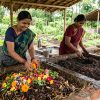
Segregation and Sun-Drying: Women collect garlands from local temples. The flowers are separated from threads, plastics, and incense packets, then dried under the sun.
The Layering (The Bed): In specialized vermibeds or pits, layers of dried flowers are mixed with cow dung (in a roughly 3:1 ratio). Cow dung provides the nitrogen and microbial starter needed to kickstart decomposition.
The Engine (Earthworms): Thousands of earthworms—most commonly the Eisenia fetida (Red Wigglers)—are introduced. These worms digest the floral waste, excreting nutrient-rich castings that form the vermicompost.
Speeding Up the Clock: The Power of Jivamrut
To ensure a faster turnaround and a more potent final product, many women’s Self-Help Groups (SHGs) have integrated Jivamrut into the process.
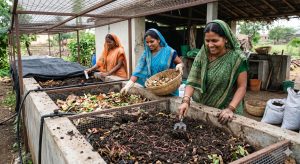
Jivamrut is a fermented liquid organic fertilizer made from:
-
Fresh cow dung and urine
-
Jaggery (as a carbon source)
-
Pulse flour (to provide protein for microbes)
-
A handful of “virgin” soil from a forest or farm
When this “elixir” is sprinkled over the vermicompost beds, it acts as a massive microbial booster. It accelerates the breakdown of tough floral cellulose and increases the earthworm population by providing an ideal environment for them to thrive. What used to take 90 days can often be completed in 50-60 days with the help of Jivamrut.
Wealth from Waste: Economic Empowerment
The impact of this initiative goes far beyond soil health. It is a powerful tool for social and financial independence:
-
Steady Income: In regions like Varanasi, women involved in flower recycling earn upwards of ₹200–₹500 daily. For many, this is the first time they have had a bank account or a stable salary.
-
Zero-Budget Entrepreneurship: Since the raw materials—temple flowers and cow dung—are often free or low-cost, the profit margins are significant. High-quality vermicompost can sell for ₹10 to ₹25 per kilogram in urban markets.
-
Education and Healthcare: Success stories from states like Karnataka show that women are using their “compost earnings” to fund their children’s higher education in fields like food technology and science.
The Circular Impact at a Glance
| Input | Process | Output | Impact |
| Temple Flowers | Vermicomposting | Organic Manure | Cleaner Rivers |
| Cow Dung | Jivamrut Application | Soil Nutrients | Sustainable Farming |
| Rural Labor | Skilled Processing | Employment | Financial Freedom |
A Greener Future
By turning “Temple Flowers” (sacred waste) into a livelihood, these women are proving that environmental conservation and economic growth are not mutually exclusive. They have moved from being “marginalized” to becoming “Green Entrepreneurs,” ensuring that the flowers offered in prayer eventually return to the earth to nourish new life.




Add comment
You must be logged in to post a comment.